UPDATENov 11, 2025
Anambra Decides 2025
The people of Anambra State went to the polls on Saturday, November 8, 2025, to elect their governor for the next four years. The election, conducted by the Independent National Electoral Commission (INEC), attracted widespread attention across Nigeria due to the state’s political significance and history of competitive elections.
The race was primarily between the incumbent governor, Professor Chukwuma Charles Soludo of the All Progressives Grand Alliance (APGA), and Nicholas Ukachukwu of the All Progressives Congress (APC). Other notable contenders included George Moghalu of the Labour Party (LP), John Chuma-Nwosu of the African Democratic Congress (ADC), and Paul Chukwuma of the Young Progressives Party (YPP). Soludo, a former Central Bank Governor and a technocrat-turned-politician, sought re-election on the strength of his first-term achievements, including infrastructure development, youth empowerment, and public sector reforms. His campaign message focused on continuity and consolidation of his “Anambra Agenda” aimed at turning the state into a hub for investment and innovation in the Southeast. Ukachukwu and other opposition candidates, however, argued that the incumbent had failed to meet expectations on job creation, security, and inclusiveness in governance, urging voters to seek change.
According to INEC data, Anambra had 2,802,790 registered voters, with women making up slightly more than half. However, turnout was low across most polling units, with reports indicating that fewer than 20% of registered voters cast their ballots. Observers from civil society groups noted that while the voting process was largely peaceful and orderly, the low participation reflected growing voter apathy and disillusionment with the political class. Security presence across the state was heavy, with thousands of police officers and soldiers deployed to maintain calm. Although a few isolated incidents of intimidation and vote-buying were reported in some local government areas, the election was generally free from major violence or disruptions.
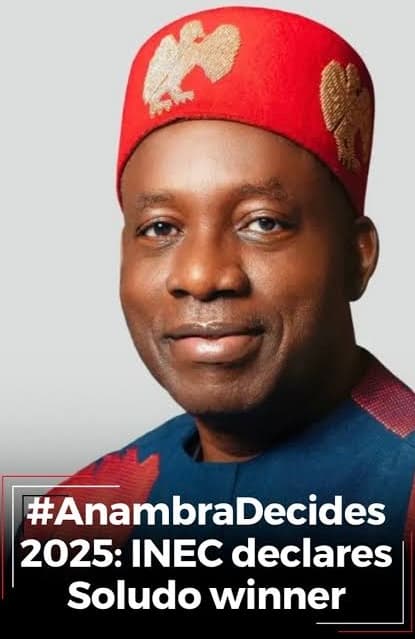
After collation at the state INEC headquarters in Awka, Professor Chukwuma Soludo was declared the winner of the election. He polled a total of 422,664 votes, defeating his closest rival, Nicholas Ukachukwu of the APC, who secured 99,445 votes. The Labour Party’s George Moghalu came in a distant third. INEC recorded 584,054 valid votes and 11,244 rejected ballots. In a remarkable show of dominance, Soludo won in all 21 Local Government Areas of Anambra State — a rare political feat that underscored APGA’s enduring grassroots structure and brand strength in the region.
The result sparked mixed reactions. Supporters of APGA celebrated across major towns, particularly in Awka, Onitsha, and Nnewi, hailing Soludo’s re-election as a victory for continuity and progress. Opposition figures, however, criticized the process, citing widespread vote-buying and voter intimidation. Civil society organizations and election observers echoed similar concerns, calling for deeper electoral reforms to restore citizens’ confidence in Nigeria’s democratic institutions. Despite the criticisms, the general consensus was that the 2025 election represented a relatively peaceful democratic exercise compared to previous cycles in the state.
Soludo’s landslide victory offers both opportunity and challenge. On one hand, his overwhelming mandate grants him political legitimacy and the freedom to push forward with his development agenda. On the other, the low voter turnout raises important questions about civic engagement and the health of democracy in the state. For Anambra’s leadership, the next four years will be critical in addressing unemployment, youth restiveness, and infrastructural decay — issues that dominated pre-election debates. The administration will also be expected to deliver tangible improvements in education, healthcare, and local government empowerment. Politically, APGA’s sweeping victory reaffirms its dominance in Anambra State, even as the Labour Party and APC continue to strengthen their grassroots networks in the Southeast. The opposition will likely turn to the courts or public campaigns to challenge aspects of the electoral process.
Governor Soludo’s second term will test his ability to build trust among disenchanted voters and maintain a balance between technocratic efficiency and political inclusion. Analysts believe his re-election could either consolidate his reputation as a reform-minded leader or expose the limitations of incumbency politics in a challenging socio-economic climate. Beyond Anambra, the election also sends a national message: voter turnout and electoral integrity remain key issues in Nigeria’s democratic evolution. The state’s experience underscores the need for stronger political education, anti-corruption measures during elections, and more transparent campaign financing.
The 2025 Anambra Governorship Election reaffirmed APGA’s political dominance under Chukwuma Soludo, who now faces the task of transforming his electoral success into meaningful governance. While the election was largely peaceful, the pervasive voter apathy and allegations of vote-buying reflect deeper systemic issues. As Soludo prepares for another four years, the people of Anambra — and indeed Nigeria — will be watching closely to see whether his second term delivers not just continuity, but renewed confidence in leadership and democracy itself.
Discussion (0)
Loading comments...